


21382
1 500 €
In stock
Relic of Saint Xenia of Rome The Righteous (5th century)
An authenticated 19th-century relic of Saint Xenia of Rome, preserved in its original sealed round theca and accompanied by the official Latin document of authentication.
The reliquary measures approximately 4 cm in diameter and 1.5 cm in thickness. It is housed beneath convex glass within a metal frame and retains its original episcopal red wax seal on the reverse, secured with silk threads according to canonical requirements established after the Council of Trent.
The intact seal confirms that the reliquary has remained unopened since its formal ecclesiastical authentication in the 19th century.
This piece represents both devotional intimacy and historical integrity, preserving the spiritual legacy of an early Christian ascetic within a carefully sealed and documented form.
Saint Xenia of Rome
Saint Xenia, also known in early sources as Eusebia, lived in the 5th century and is venerated as a model of voluntary renunciation and hidden holiness.
Born into a noble Roman family, she was betrothed against her will. Desiring to dedicate her life entirely to Christ, she secretly fled her homeland with two devoted companions. To conceal her identity and avoid being discovered, she took the name Xenia, meaning “stranger” or “pilgrim.”
She eventually settled in Mylasa in Caria (Asia Minor), where she:
- Founded a convent for women
- Lived in extreme humility and ascetic discipline
- Devoted herself to prayer, fasting, and works of charity
- Guided other women in consecrated religious life
Saint Xenia embodied a specifically early Christian form of holiness: the quiet renunciation of worldly privilege in favor of spiritual freedom. Her life reflects the ideals of virginity, humility, and inner detachment that shaped the spirituality of late antiquity.
Tradition recounts that at the time of her death, a radiant sign appeared in the heavens — a luminous cross crowned with stars — symbolizing divine approval of her hidden sanctity.
She is honored as a patroness of:
- Those seeking freedom from unwanted obligations
- Women dedicated to religious life
- Pilgrims and spiritual seekers
Feast Day: January 24 (Eastern tradition).
Saint Xenia’s sanctity is marked not by dramatic martyrdom but by courageous interior renunciation — a holiness expressed in silence, constancy, and devotion.
The Authenticating Authority
The accompanying Latin document bears the authority of Victor-Auguste-Isidore Cardinal Deschamps (1810–1883), Archbishop of Mechelen and Primate of Belgium.
Deschamps was one of the most influential Belgian churchmen of the 19th century. A member of the Redemptorist Order before his episcopal appointment, he became Archbishop of Mechelen in 1867 and was later created Cardinal.
As Archbishop, he exercised canonical jurisdiction over the authentication of relics. Following the strict post-Tridentine norms:
- Relics were examined and formally approved
- Placed within a metal theca
- Secured with silk threads
- Sealed in red wax bearing his episcopal coat of arms
- Accompanied by a signed and stamped Latin authentica
The preserved wax seal on this reliquary confirms that it has remained intact since its official recognition.
Cardinal Deschamps was also known for his theological clarity, participation in the First Vatican Council (1869–1870), and strong defense of Catholic doctrine in a period of intense political and intellectual change.
Devotional and Historical Significance
Relics of early ascetic saints such as Saint Xenia are comparatively rare and represent a particularly ancient stream of Christian spirituality — the sanctity of hidden sacrifice and contemplative life.
This relic unites:
- Early Christian monastic ideals
- 19th-century ecclesiastical authentication practice
- Preserved seal integrity
- Original documentation
Compact yet deeply expressive of early Christian piety, it stands as a devotional artifact linking the world of late antique asceticism with the careful canonical traditions of the modern Church.
------ Ask for authenticity documents in private messages at info@saintsrelics.com ------
Another items fromRELICS
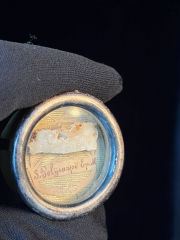
Reliquary with the Relics of Saint Polycarp of Smyrna, Bishop and Martyr
1 300 €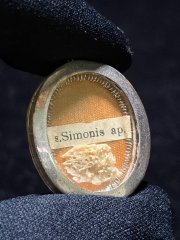
Relic of Saint Simon the Apostle in pure sterling silver reliquary
1 500 €

Silver Reliquary with Major Relics of Saint Hilary of Poitiers
1 500 €
Reliquary-Sarcophagus with the Relics of Saint Martin I, Pope and Martyr
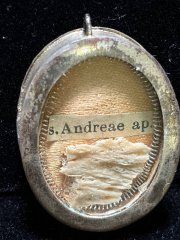
Relic of Saint Andrew the Apostle in pure sterling silver reliquary
1 500 €