


21304
1 200 €
In stockRelic of Saint Eugene of Melitene, Martyr
With Episcopal Authentication Document (1873)
A finely preserved 19th-century reliquary containing sacred relics (ex ossibus) of Saint Eugene of Melitene, venerated as a Christian martyr of the early Church. The relic is housed in a compact circular reliquary, carefully constructed and traditionally sealed, reflecting the sober yet dignified devotional objects produced for private veneration in the late 19th century.
The reliquary is accompanied by its original Instrumentum Authenticitatis, issued in 1873 by the Bishop of the Diocese of Todi (Tutela / Tutelensis). This official ecclesiastical document certifies the authenticity of the relic, confirms its extraction from an approved source, and authorizes its public or private veneration in accordance with canon law. The presence of the episcopal seal and signature provides clear provenance and uninterrupted devotional legitimacy.
Dimensions: 2.5 × 2.5 cm
Period: 1873
Condition: Well preserved, with intact seal and legible titulus
Saint Eugene of Melitene — Martyr
Saint Eugene of Melitene (also known as Eugenius of Melitene) was a Christian martyr who suffered for his faith during the Roman persecutions, traditionally dated to the early centuries of Christianity. Melitene, located in ancient Armenia Minor (modern eastern Anatolia), was an important frontier city of the Roman Empire and an early center of Christian witness.
Saint Eugene is remembered for his steadfast confession of Christ in the face of torture and death, embodying the heroic fidelity of the early martyrs whose blood was regarded by the Church as the seed of faith. His cult spread through both Eastern and Western Christian traditions, and his relics were venerated as tangible testimonies of courage, endurance, and unwavering devotion to Christ.
The Episcopal Authority and the Document
The authentication document was issued under the authority of the Bishop of Todi, an Italian diocese with a long episcopal lineage dating back to Late Antiquity. In the 19th century, bishops were entrusted with the strict supervision of relics, ensuring their authenticity, proper sealing, and lawful circulation. Such documents were mandatory for relics intended for veneration, and their absence would invalidate ecclesiastical use.
This document confirms:
- the identity of the saint,
- the material nature of the relic (ex ossibus),
- the proper enclosure and sealing of the reliquary,
- and the bishop’s authorization for veneration.
Significance
This reliquary represents a genuine devotional object of the Catholic Church, combining historical faith, episcopal authority, and documented provenance. It stands as both a sacred relic and a small yet meaningful artifact of 19th-century ecclesiastical practice—linking the witness of an early Christian martyr with the living tradition of the Church centuries later.
------ Ask for authenticity documents in private messages at info@saintsrelics.com ------
Another items fromRELICS

Large Relic from the Rib of Saint James the Greater, Apostle (ex costa).
1 500 €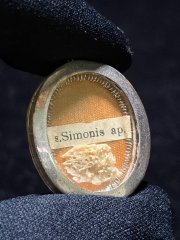
Relic of Saint Simon the Apostle in pure sterling silver reliquary
1 500 €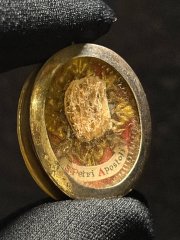
Relic of Saint Peter the Apostle in Pure Sterling Silver Reliquary
1 500 €
Relic of Saint James the Less, Apostle in pure sterling silver reliquary
1 500 €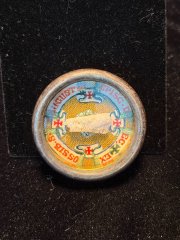
Large First-Class Relic of Saint Augustine of Hippo, Bishop and Doctor of the Church
1 500 €
Silver Reliquary with Major Relics of Saint Hilary of Poitiers
1 500 €