

21493
1 800 €
In stockLarge First-Class Relics of Saints Zenaida and Philonella of Tarsus The Holy Unmercenary Physicians and Martyrs — Relatives of Saint Paul the Apostle
Gilt-Bronze Reliquary with Original Episcopal Authentica of Bishop of Veroli — 1930
An exceptionally rare and historically important gilt-bronze reliquary containing two unusually large first-class relics (ex ossibus) of the Holy Martyrs Zenaida and Philonella of Tarsus, the celebrated first-century Christian sisters, physicians and Unmercenary Healers traditionally associated with Saint Paul the Apostle.
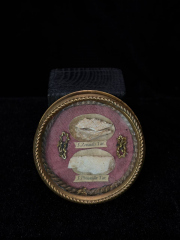
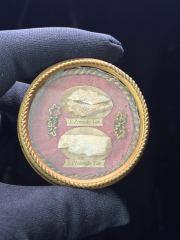
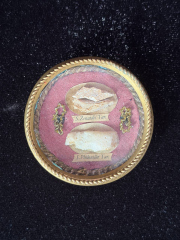
The relics are preserved within a handsome circular gilt-bronze theca measuring approximately 5.5 cm in diameter and 1.5 cm in thickness. Beneath the glass, the two substantial bone fragments are arranged vertically upon an antique rose-colored textile ground and surrounded by delicate metallic ornaments.
The considerable dimensions of the relic fragments are immediately striking. These are not the minute particles frequently encountered in later devotional thecae, but two clearly visible and substantial fragments of bone, each individually identified.
The reverse retains the original episcopal sealing system, including the historic red wax seal bearing the ecclesiastical arms corresponding to those printed upon the accompanying certificate.
Most importantly, the reliquary remains accompanied by its original episcopal Authentica, issued at Veroli in March 1930 under the authority of Luigi Fantozzi, Bishop of Veroli.
Saints Zenaida and Philonella of Tarsus
Saints Zenaida (Zenais) and Philonella are among the most fascinating female saints of primitive Christianity.
According to ancient Eastern Christian tradition, the two were sisters from Tarsus in Cilicia, the same celebrated city from which Saint Paul the Apostle came. Ecclesiastical tradition describes them as relatives of Saint Paul, and they belong to the earliest generation of Christians associated with the apostolic age. The Orthodox Church in America likewise records them as first-century women of Tarsus who were related to the Apostle Paul.
Their importance is particularly remarkable because Christian tradition remembers them not only as holy women and martyrs, but as physicians.
Both sisters received an education unusual for women of their period and acquired medical knowledge. Eventually they left Tarsus and established themselves near Demetriada in Thessaly, where they combined a life of prayer with the treatment of the sick.
They became celebrated as Anargyroi — Holy Unmercenaries, physicians who treated the sick without demanding payment. In this respect Zenaida and Philonella stand at the very beginning of the great Christian tradition later represented by such celebrated healing saints as Cosmas and Damian, Panteleimon, Cyrus and John.
Their medical vocation was inseparable from their Christian faith: the sick who came to them received both physical care and Christian consolation.
Eastern tradition relates that the sisters eventually suffered martyrdom when pagans attacked their dwelling and stoned them to death. They are commemorated together on 11 October in the Eastern Orthodox tradition.
Their lives therefore unite several exceptionally important themes of early Christianity: the apostolic age, the circle of Saint Paul, female Christian scholarship, medicine as an act of charity, the tradition of the Holy Unmercenaries, and martyrdom for Christ.
The Connection with Saint Paul the Apostle
The association with Saint Paul is especially significant for this reliquary.
Zenaida and Philonella were natives of Tarsus, Saint Paul's own city, and Christian tradition regards them as his relatives. Some later traditions identify them specifically as his cousins.
This connection appears to be reflected directly in the handwritten text of the accompanying Authentica. The manuscript portion identifies the sacred particles as relics “ex ossibus S. Zenaidis et Philonillae Tarsensium…” — from the bones of Saints Zenaida and Philonella of Tarsus — and continues with a reference to Paul the Apostle.
Thus the ecclesiastical certificate itself preserves the traditional association of these two saints with the apostolic circle.
This is a particularly attractive aspect of the ensemble: the identities recorded upon the individual relic labels, the episcopal document, and the ancient hagiographical tradition correspond with one another.
The Reliquary
The sacred remains are housed in a finely made circular gilt-bronze reliquary, or theca, characteristic of ecclesiastical relic presentation.
Dimensions
- Diameter: approximately 5.5 cm
- Thickness: approximately 1.5 cm
The interior composition is restrained and elegant.
Against a faded rose-red textile background are mounted two large bone fragments, one above the other. Each occupies its own oval field and is accompanied by its historical cedula.
Small gilt ornaments placed symmetrically to either side of the upper relic provide a decorative accent without distracting from the relics themselves.
A twisted metallic border surrounds the interior, while the substantial gilt-bronze outer case gives the object a particularly solid and dignified appearance.
The relics display the natural porous and cortical structure expected of old osseous material, and their large dimensions make them exceptionally impressive when compared with the tiny particles ordinarily encountered in portable reliquaries of this period.
Original Episcopal Seal
The reverse preserves an especially important element of the ensemble: the original red wax ecclesiastical seal.
The wax impression displays the episcopal coat of arms and remains seated within the rear of the metal reliquary.
The same heraldic composition appears in relief upon the official seal impressed into the accompanying Authentica and in printed form at the head of the certificate.
This correspondence between the reliquary seal, the embossed document seal and the episcopal arms printed on the Authentica provides an important visual link between the physical reliquary and its documentary authentication.
The Original Authentica — Veroli, 1930
The reliquary is accompanied by its large original ecclesiastical certificate of authenticity.
The Authentica formally recognizes the sacred particles, records their placement within the reliquary, and grants permission for their preservation and public veneration according to the customary canonical formula.
It bears the episcopal authentication and diocesan signatures and is further distinguished by an embossed episcopal seal, corresponding to the heraldic device found upon the reliquary itself.
The certificate is dated at Veroli in March 1930, during the final period of Luigi Fantozzi's long episcopate.
Historical and Devotional Importance
This ensemble is remarkable for several reasons.
First is the rarity of the saints themselves. Reliquaries of Saints Zenaida and Philonella appear far less frequently than those of the better-known Western saints or even the great Eastern Unmercenary physicians Cosmas and Damian.
Second is the extraordinary pairing. The two sisters remain together in the same reliquary, preserving their historical and spiritual relationship rather than separating their relics into individual thecae.
Third is the size of the relics. Both fragments are substantial, clearly visible pieces of bone rather than particles.
Fourth is the survival of the original episcopal Authentica, which identifies the saints and provides an ecclesiastical documentary context for the reliquary.
Finally, the saints themselves occupy a fascinating position in Christian history. They belong by tradition to the first Christian century, are associated with Saint Paul and apostolic Tarsus, are remembered as among the earliest Christian women physicians, and became prototypes of the charitable medical tradition of the Holy Unmercenaries.
For a collection devoted to Early Christianity, apostolic saints, Christian medicine, female saints, martyrs, Eastern Christianity or the cult of sacred relics, this is therefore a particularly unusual and evocative object.
Catalogue Details
Object: Gilt-bronze circular ecclesiastical reliquary (theca)
Dimensions: approximately 5.5 cm diameter × 1.5 cm thickness
Material: Gilt bronze, glass, textile, metallic decoration, paper cedulae.
Authentication: Original episcopal red wax seal preserved on the reverse.
Accompanying document: Original ecclesiastical Authentica.
Date: March 1930
Place: Veroli, Italy
Issuing ecclesiastical authority: Most Rev. Luigi Fantozzi, C.Pp.S., Bishop of Veroli, subsequently Titular Archbishop of Dara.
Special significance: An exceptionally uncommon authenticated double reliquary preserving large first-class relics of two sisters of the Apostolic Age — Saints Zenaida and Philonella of Tarsus, early Christian physicians and Holy Unmercenaries traditionally associated by kinship with Saint Paul the Apostle — together with its original 1930 episcopal documentation and sealing.
------ Ask for authenticity documents in private messages at info@saintsrelics.com ------


