

21480
No price set
Out of stock
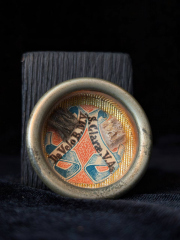
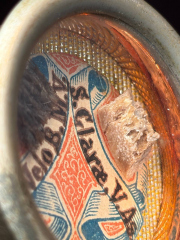
Authentic Theca Reliquary of Saint Clare of Assisi and the Veil of the Blessed Virgin Mary Containing a Relic of Saint Clare of Assisi and an Ex Velo of the Blessed Virgin Mary
Original Episcopal Authentication – 1841
An exceptional nineteenth-century theca reliquary containing two highly venerated relics: a relic from the bones of Saint Clare of Assisi (ex ossibus Sanctae Clarae Assisiensis Virginis) and a relic from the Veil of the Blessed Virgin Mary (de Velo Beatae Mariae Virginis).
The relics are carefully arranged beneath the original crystal within an elegant circular theca. The reverse preserves its original silk threads and an intact episcopal wax seal, confirming that the reliquary has remained unopened since its official authentication. Accompanying the reliquary is the original Authentica, issued in 1841, providing unquestionable ecclesiastical provenance.
The combination of a relic of Saint Clare, one of the greatest female saints of Christianity, together with a relic traditionally identified as coming from the Veil of the Blessed Virgin Mary, makes this an exceptionally desirable devotional object of remarkable rarity.
Saint Clare of Assisi (1194–1253)
Saint Clare of Assisi was one of the most beloved women of the Middle Ages and the closest spiritual companion of Saint Francis of Assisi. Born into a noble family, she abandoned a life of privilege after hearing Francis preach and dedicated herself entirely to Christ in a life of poverty, prayer, and contemplation.
She became the founder of the Order of Poor Ladies, later known as the Poor Clares, whose monasteries quickly spread throughout Europe. Saint Clare faithfully preserved the Franciscan ideal of complete dependence upon Divine Providence, becoming a powerful witness to humility, charity, and joyful poverty.
She is especially remembered for her unwavering courage during the Saracen attack on the monastery of San Damiano. Tradition recounts that she carried the Blessed Sacrament before the invaders and confidently entrusted the community to Christ's protection, after which the attackers withdrew.
Canonized only two years after her death by Pope Alexander IV, Saint Clare has remained one of the most universally loved saints of the Catholic Church. She is honored as the patron saint of television, communications, embroiderers, and those seeking spiritual clarity. Authentic relics of Saint Clare are highly sought after and rarely appear on the market.
The Veil of the Blessed Virgin Mary
The relic identified as de Velo Beatae Mariae Virginis belongs to one of the most revered classes of Marian relics preserved within the Catholic tradition.
From the earliest centuries of Christianity, garments associated with the Blessed Virgin Mary have been treasured as tangible reminders of the Mother of God. Fragments traditionally identified as originating from her veil have long been preserved in important churches and monasteries and have inspired profound Marian devotion throughout both the Eastern and Western Churches.
Such relics are not only connected with the earthly life of the Virgin Mary but also symbolize her maternal protection, purity, and perpetual intercession for the faithful. Because authentic fragments were always distributed only in extremely small portions, officially authenticated examples accompanied by original ecclesiastical documentation are exceptionally uncommon.
Cardinal Engelbert Sterckx (1792–1867)
The accompanying Authentica was issued under the authority of Cardinal Engelbert Sterckx, one of the most influential Catholic prelates of nineteenth-century Europe.
Cardinal Sterckx served as Archbishop of Mechelen (Malines) and Primate of Belgium from 1832 until his death. Created Cardinal by Pope Gregory XVI in 1838, he became one of the leading defenders of the Catholic Church during a period of profound political and religious change following the independence of Belgium.
Renowned for his wisdom, moderation, and pastoral leadership, Cardinal Sterckx played a decisive role in strengthening Catholic education, promoting religious life, and safeguarding the Church's independence. His authority extended throughout Belgium, and relics authenticated under his seal are recognized for their exceptional ecclesiastical credibility.
The original episcopal seal and official document accompanying this reliquary testify that the relics were canonically examined, enclosed, sealed, and approved for public veneration according to the norms of the Catholic Church.
Dimensions
- Diameter: 4 cm (1.57 in)
- Thickness: 1 cm (0.39 in)
Summary
This remarkable nineteenth-century theca reliquary unites two extraordinary relics—from the bones of Saint Clare of Assisi and from the Veil of the Blessed Virgin Mary—within a single authenticated reliquary accompanied by its original Authentica dated 1841.
Combining exceptional devotional significance, impeccable ecclesiastical provenance, intact seals, and excellent preservation, it represents a museum-quality example of Catholic sacred art and an outstanding relic of Franciscan and Marian devotion.
------ Ask for authenticity documents in private messages at info@saintsrelics.com ------


