21531
1 500 €
In stock
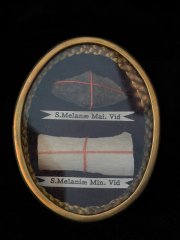
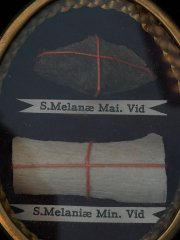
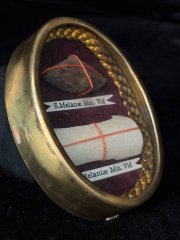
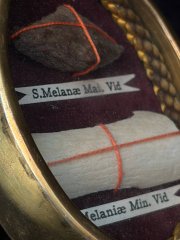
Authentic Large Theca Reliquary of Saint Melania the Elder and Saint Melania the Younger Containing Large Relics of Two of the Greatest Desert Mothers of Early Christianity
Original Episcopal Authentication – 1864
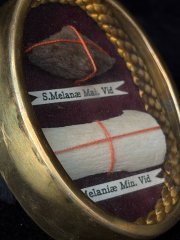
Presented here is an exceptional and highly important nineteenth-century large oval theca reliquary containing substantial relics of Saint Melania the Elder (Sancta Melania Maior) and Saint Melania the Younger (Sancta Melania Minor), two of the most revered holy women of the early Church and among the founders of Christian monasticism in the Holy Land.
The reliquary preserves two unusually large relics carefully mounted beneath the original crystal, each identified by its original handwritten label. The reverse retains the original silk threads and intact episcopal wax seal, confirming that the reliquary has never been opened since its solemn ecclesiastical authentication.
Accompanying the reliquary is its original Authentica, issued in 1864, guaranteeing the canonical authenticity and lawful ecclesiastical approval of these sacred relics.
Large authenticated relics of either Melania are exceptionally scarce; a reliquary preserving both saints together represents an outstanding rarity.
Saint Melania the Elder (c. 342–410)
Saint Melania the Elder was one of the most influential Christian women of the fourth century. Born into an immensely wealthy Roman senatorial family, she became a widow at an early age and chose to dedicate her entire fortune to Christ, embracing a life of prayer, charity, and asceticism.
She traveled first to Egypt, where she lived among the Desert Fathers, learning directly from many of the greatest monastic saints of the age. Later she settled in Jerusalem, where she established monasteries, hospitals, and houses for pilgrims, supporting both the poor and persecuted Christians throughout the East.
Saint Melania became closely associated with some of the greatest Fathers of the Church, including Saint Jerome, Saint Rufinus of Aquileia, and many of the early desert ascetics. Her generosity preserved countless monastic communities during periods of persecution and political unrest.
She is remembered as one of the principal founders of Christian monastic life in Palestine and remains an enduring model of charity, humility, and complete detachment from worldly wealth.
Saint Melania the Younger (c. 383–439)
Saint Melania the Younger, granddaughter of Saint Melania the Elder, inherited the same noble Roman lineage but surpassed even her grandmother in voluntary poverty and devotion.
Married at a young age to the equally devout Saint Pinian, the couple eventually renounced one of the largest fortunes in the Roman Empire. They sold vast estates throughout Italy, Spain, North Africa, and Gaul, distributing enormous wealth to churches, monasteries, hospitals, and the poor.
Following years of pilgrimage, Melania and Pinian settled permanently in Jerusalem, where they founded monasteries for both men and women and devoted themselves entirely to prayer, fasting, Scripture, and works of mercy.
Saint Melania became one of the most respected spiritual mothers of the Eastern Church. Pilgrims, bishops, monks, and even members of the imperial court sought her counsel. She died in Jerusalem in 439, leaving a legacy that profoundly influenced Christian monasticism for centuries.
Together, Saint Melania the Elder and Saint Melania the Younger represent two generations of extraordinary sanctity whose lives helped shape the spiritual landscape of the Christian East.
Bishop Giovanni Battista Antonio Benvenuti (1818–1895)
The accompanying Authentica bears the authority of Bishop Giovanni Battista Antonio Benvenuti, Bishop of Modigliana, under whose jurisdiction the relics were officially examined, sealed, and authenticated in 1864.
Bishop Benvenuti was known for his careful pastoral administration and his strict adherence to the canonical regulations governing sacred relics. During the nineteenth century, bishops were entrusted with ensuring that relics intended for public veneration were accompanied by proper ecclesiastical documentation and sealed according to the prescriptions of the Holy See.
Authentications issued under his episcopal authority followed the rigorous procedures established by Roman canon law. Each relic was examined, enclosed within a theca, secured with silk threads, sealed with the bishop's official wax seal, and accompanied by an Authentica, certifying both its identity and its lawful authorization for public veneration.
Because of these procedures, reliquaries accompanied by their original documentation and preserving intact episcopal seals are regarded as particularly desirable examples of authenticated Catholic devotional heritage.
Condition
- Original silk bindings
- Original intact episcopal wax seal
- Original Authentica dated 1864
The unusually large relics remain securely preserved exactly as authenticated in the nineteenth century.
Dimensions
- Height: 9 cm (3.54 in)
- Width: 7 cm (2.76 in)
- Thickness: 2 cm (0.79 in)
Summary
This remarkable museum-quality reliquary combines exceptionally large authenticated relics of Saint Melania the Elder and Saint Melania the Younger, two of the greatest women of the early Christian Church whose lives transformed the development of monasticism in the Holy Land.
Complete with its original Authentica, intact episcopal seal, and outstanding state of preservation, it represents an exceptionally rare and historically significant example of nineteenth-century Catholic devotional art and ecclesiastical heritage.
------ Ask for authenticity documents in private messages at info@saintsrelics.com ------
Another items fromRELICS
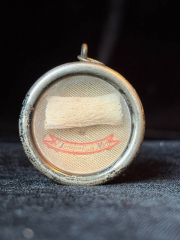
Reliquary with the Relic of a Holy Innocent of Bethlehem, Martyr
1 500 €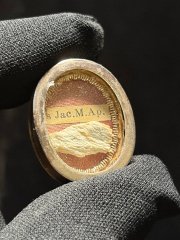
Relic of Saint James the Greater, Apostle in pure sterling silver reliquary
1 500 €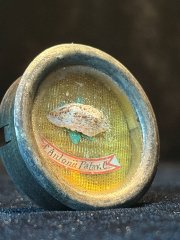
Large First-Class Relic of Saint Anthony of Padua Confessor
1 400 €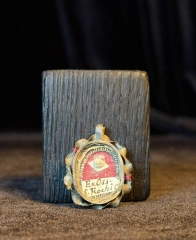
Sterling silver theca - reliquary with relic of St. Roch, Confessor
1 200 €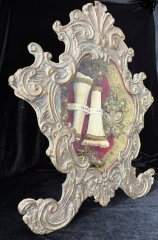
Exceptional Reliquary of Saints Celsus and Nazarius With Very Large First-Class Relics
5 300 €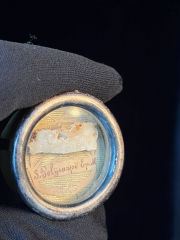
Reliquary with the Relics of Saint Polycarp of Smyrna, Bishop and Martyr
1 300 €