

21490
2 100 €
In stockReliquary with Large Relics of Saint Ambrose, Saint Marcellina and Saint Satyrus of Milan
Three Siblings of the Early Church
Original Episcopal Authentica, 1850
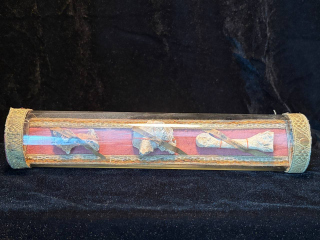
An exceptionally important mid-19th-century cylindrical reliquary containing three remarkably substantial sacred relics of Saint Ambrose of Milan, Saint Marcellina of Milan, and Saint Satyrus of Milan — the celebrated brother, sister and brother of one of the most distinguished Christian families of Late Antiquity.
The relics are preserved together in a long glazed cylindrical shrine measuring approximately 25 cm in length and 5 cm in diameter. Each relic is individually identified by its original Latin cedula. Particularly noteworthy is the unusually generous size of the three osseous fragments: these are not minute particles but clearly visible and substantial portions of bone.
The relics are arranged upon a deep red textile ground and framed by historic metallic ecclesiastical braid. Their presentation together is especially meaningful because Ambrose, Marcellina and Satyrus were siblings, intimately connected not merely by family but by their shared Christian life and the history of the Church of Milan.
The reliquary is accompanied by its original ecclesiastical Authentica dated 10 July 1850, issued in Modena and bearing the episcopal arms, official seal and signatures.
The Three Relics
The handwritten portion of the certificate identifies:
- S. Ambrosii Mediolanensis Episcopi et Confessoris
Saint Ambrose of Milan, Bishop and Confessor - S. Marcellinae Mediolanensis Virginis
Saint Marcellina of Milan, Virgin - S. Satyri Mediolanensis Confessoris
Saint Satyrus of Milan, Confessor
The remarkable survival of all three relics together, with their contemporary documentation, gives the ensemble an unusual historical and devotional unity.
Saint Ambrose of Milan
Saint Ambrose (c. 339–397) is one of the towering figures of Western Christianity and one of the Four Great Latin Doctors of the Church, together with Saints Augustine, Jerome and Gregory the Great.
Born into an important Roman Christian family, Ambrose pursued an administrative career and became governor of the provinces of Liguria and Emilia. In one of the most extraordinary episodes in early Church history, while still a catechumen he was acclaimed Bishop of Milan by the people during the disputed episcopal election of 374.
He was baptized and, shortly afterwards, consecrated bishop.
Ambrose became an enormously influential theologian, preacher, defender of Nicene Christianity and ecclesiastical statesman. His writings on Scripture, Christian ethics, the sacraments and virginity profoundly influenced the development of Western theology.
His relationship with Saint Augustine of Hippo is particularly famous. Augustine listened to Ambrose preaching in Milan, and Ambrose ultimately baptized Augustine at Easter in 387 — an event of immense significance for the history of Christianity.
Ambrose died in Milan in 397. His relics are famously associated with the Basilica of Sant'Ambrogio in Milan, the church that remains one of the principal monuments of the ancient Christian West.
He is venerated in both the Catholic and Orthodox Churches.
Saint Marcellina of Milan
Saint Marcellina was the elder sister of Ambrose and Satyrus and one of the notable consecrated virgins of the 4th-century Church.
She dedicated herself to a life of Christian virginity at an early age and received the veil of consecration in Rome from Pope Liberius, traditionally associated with Christmas Day, probably in the 350s.
Marcellina exercised a profound spiritual influence upon her younger brothers. Ambrose's famous treatise De Virginibus (On Virgins) was addressed to his sister, providing an extraordinary direct literary connection between two saints whose relics are reunited in this reliquary.
After the death of Ambrose, Marcellina continued to be venerated within the Milanese Church. Her relics are traditionally preserved in Milan.
Saint Satyrus of Milan
Saint Satyrus (Satyre/Satyrus) was the beloved brother of Ambrose and Marcellina.
Although less internationally famous than Ambrose, Satyrus occupies a particularly touching place in early Christian literature because Ambrose himself left us an intimate testimony to his brother in the funeral orations known as De excessu fratris Satyri — "On the Death of His Brother Satyrus."
Satyrus had assisted Ambrose in the administration of his temporal affairs and was exceptionally close to him. His premature death, around 378, deeply affected Ambrose.
The surviving funeral addresses are therefore much more than conventional hagiography: they constitute the testimony of one saint mourning another who was also his own brother.
The preservation here of relics of all three siblings together — Ambrose, Marcellina and Satyrus — is consequently particularly evocative.
The 1850 Episcopal Authentica
The accompanying certificate is itself an important historical document.
It is headed:
ALOYSIUS FERRARI
Dei et Apostolicae Sedis Gratia Ecclesiae Episcopus...
The issuer was Luigi (Aloysius) Ferrari (1792–1851), Bishop of Modena and Nonantola.
Ferrari was born in Modena on 1 November 1792, was ordained priest in 1815 and was appointed Bishop of Modena and Nonantola by Pope Pius IX on 3 July 1848. He received episcopal consecration on 17 September 1848 and governed the diocese until his death on 19 April 1851.
This makes the date of the present Authentica — 10 July 1850 — particularly interesting: the document was issued during Ferrari's comparatively short episcopate of less than three years, only approximately nine months before his death.
Ferrari's episcopal succession was itself firmly embedded in the historic Italian hierarchy. He was principally consecrated by Bishop Filippo Cattani of Reggio Emilia, assisted by Bishop Pietro Raffaelli of Carpi and Bishop Pietro Giovanni Zanardi of Guastalla.
The elaborate titles printed at the head of the certificate also reflect the historic union of the Diocese of Modena with the Territorial Abbey of Nonantola, which had taken place in 1820. Ferrari succeeded Luigi Reggianini and was followed after his death by Francesco Emilio Cugini.
Of particular relevance to the provenance of this object, surviving archival inventories in Emilia-Romagna record relic authentications issued by Luigi Ferrari in 1849 and 1850, independently confirming his activity in precisely this ecclesiastical function during the period of the present document.
The certificate states that the sacred particles had been duly recognized and were reverently placed within their reliquary, secured according to ecclesiastical practice and authenticated under episcopal authority.
The surviving document therefore provides a direct nineteenth-century ecclesiastical provenance for the three relics.
Historical and Devotional Significance
This is a particularly compelling reliquary because it brings together three members of the same extraordinary fourth-century Christian family.
Rather than an unrelated collection of saints, it preserves the relics of three siblings whose lives were intimately intertwined:
- Marcellina, the consecrated virgin and elder sister;
- Ambrose, Bishop of Milan and Doctor of the Church;
- Satyrus, whose death inspired one of Ambrose's most personal surviving literary works.
The unusually large size of the individual relics, the survival of their original handwritten labels, their presentation together within a substantial nineteenth-century cylindrical reliquary, and especially the preservation of the matching episcopal Authentica of 1850, make the ensemble one of considerable historical, devotional, and lipsanological importance.
Relics: Saint Ambrose of Milan, Bishop, Confessor and Doctor of the Church; Saint Marcellina of Milan, Virgin; Saint Satyrus of Milan, Confessor
Relationship: Three Siblings — Ambrose, Marcellina and Satyrus
Reliquary: Glazed Cylindrical Shrine with Original Textile and Metallic Braid Decoration
Dimensions: Approximately 25 cm × 5 cm
Authentica: Modena, 10 July 1850
Issued by: Luigi (Aloysius) Ferrari, Bishop of Modena and Nonantola (1792–1851)
Documentation: Original Episcopal Authentica with Ecclesiastical Seal and Signatures
Period: Mid-19th Century
Special Significance: Three unusually substantial relics of one of the most celebrated sibling groups of the Early Christian Church, preserved together with their original episcopal authentication.
The preservation of these three relics within a single reliquary represents far more than a simple gathering of saints. It preserves the spiritual legacy of one remarkable Christian family whose influence shaped the development of the early Church.
Saint Ambrose became one of the greatest theologians of Western Christianity. Saint Marcellina dedicated her life entirely to God and inspired her brothers through her example of holiness. Saint Satyrus, though less widely known, became immortalized through the deeply personal writings of his brother Ambrose, providing one of the earliest and most moving testimonies of Christian family devotion.
The combination of these three siblings within one reliquary, together with unusually substantial first-class relics, original Latin identification labels, the surviving nineteenth-century cylindrical shrine, and the complete episcopal Authentica issued in 1850, creates an ensemble of exceptional historical, devotional, and museum significance.
Objects preserving relics of several members of the same saintly family are exceedingly uncommon. The survival of this complete set, accompanied by its original ecclesiastical authentication and preserved in its historic presentation, makes this reliquary an outstanding example of nineteenth-century Catholic devotional art and an important witness to the continuity of relic veneration within the Church.
Another items fromRELICS
RESERVED - Multi-Relic Reliquary of Thirteen Early Christian Saints

Relic of Saint Nicholas of Myra Ex Costa From the Rib of Saint Nicholas the Wonderworker
2 100 €
Reliquary with a Relic of the Garment of Saint Joseph ( Spouse of the Blessed Virgin Mary)
1 500 €
Reliquary with relic of Saint Acathius Melitene
1 200 € 1 200 €
Reliquary of Saint Leo the Great, Pope
1 400 €