


21309
No price set
Out of stock
Relic of Saint John the Almsgiver John V Eleemon (Greek: Ἰωάννης ὁ Ἐλεήμων, also known as John the Almsgiver, John the Almoner, John the Compassionate, or John the Merciful
- Patriarch of Alexandria + Episcopal Certificate of Authentication, 1883)
This devotional object contains a relic ex ossibus (from the bones) of Saint John the Almsgiver (Sanctus Ioannes Eleemosynarius), Patriarch of Alexandria.
The relic is preserved in a circular metal reliquary, measuring 4 cm in diameter, with a glazed front revealing the relic fragment mounted on a textile ground. Beneath the relic is a contemporary handwritten identification label reading “Joannis El. Ep.”, indicating Saint John the Almsgiver in his episcopal dignity.
The reverse of the reliquary is secured with its original red episcopal wax seal, bearing a clearly impressed coat of arms, confirming that the reliquary has remained unopened since its official sealing. The reliquary is complete, intact, and preserved in canonical condition.
Episcopal Certificate of Authentication (1883)
Accompanying the reliquary is the original Latin episcopal certificate of authentication, dated 1883, issued in accordance with the norms of the Council of Trent governing the verification and veneration of sacred relics.
The document certifies that:
- the relic was examined, recognized, and formally approved as genuine;
- it was reverently enclosed in a proper reliquary, secured with silk thread, and sealed with episcopal wax;
- it was authorized for public veneration by the faithful.
The certificate bears the printed coat of arms, official signatures, and seal of the issuing ecclesiastical authority, directly corresponding to the seal on the reliquary.
The Issuing Bishop
The certificate was issued under the authority of Victor Auguste-Isidore Dechamps (Victor Augustus Isidorus Dechamps).
- Cardinal of the Holy Roman Church
- Archbishop of Mechelen, Primate of Belgium
- Leading Catholic theologian and churchman of the 19th century
- Prominent defender of ecclesiastical discipline and orthodoxy in the post–Vatican I period
His authority and seal confer a high level of historical, canonical, and devotional credibility on this relic.
Saint John the Almsgiver († 616/620)
Saint John the Almsgiver, also known as John the Merciful, served as Patriarch of Alexandria in the early 7th century and is venerated in both the Eastern Orthodox and Roman Catholic traditions.
He is renowned for:
- his exceptional charity toward the poor, widows, orphans, and the sick;
- organizing large-scale and systematic almsgiving;
- governing the Church of Alexandria with humility, compassion, and pastoral wisdom during a time of political and social instability.
Because of his boundless mercy, he was universally known as Eleemosynarius — “the Almsgiver.” His cult spread widely throughout the Christian world, and relics associated with him have long been held in deep reverence.
Significance
This complete ensemble — consisting of the reliquary, its intact episcopal seal, and the matching episcopal certificate dated 1883 — represents a fully documented 19th-century Catholic relic.
It is:
- canonically authenticated and historically traceable,
- suitable for scholarly, ecclesiastical, or museum contexts,
- a tangible witness to Catholic devotional practice and episcopal authority,
- directly connected to one of Christianity’s most revered saints of mercy and charity.
------ Ask for authenticity documents in private messages at info@saintsrelics.com ------
Another items fromRELICS
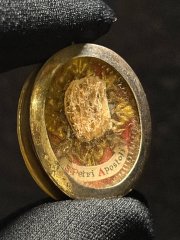
Relic of Saint Peter the Apostle in Pure Sterling Silver Reliquary
1 500 € 1 200 €
 1 200 €
Relic of Saint Eugene of Melitene, Martyr
1 200 €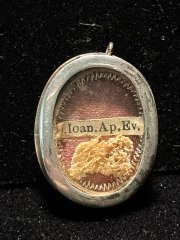
Relic of Saint John the Apostle and Evangelist in pure sterling silver reliquary
1 500 €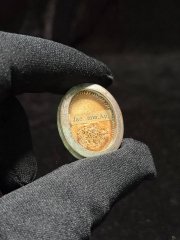
Relic of Saint James the Less, Apostle in pure sterling silver reliquary
1 500 €